シグモイド関数とtanh関数
定義 1 tanh関数
双曲線正接関数(hyperbolic tangent function)tanh (x) : ℝ → ℝ の定義は以下
$$ \begin{eqnarray*}\tanh \left( x\right) &=&\frac{\sinh \left( x\right) }{\cosh \left( x\right) } \\ &=&\frac{\frac{e^{x}-e^{-x}}{2}}{\frac{e^{x}+e^{-x}}{2}} \\ &=&\frac{e^{x}-e^{-x}}{e^{x}+e^{-x}} \end{eqnarray*} $$
例 1 tanh関数の形状
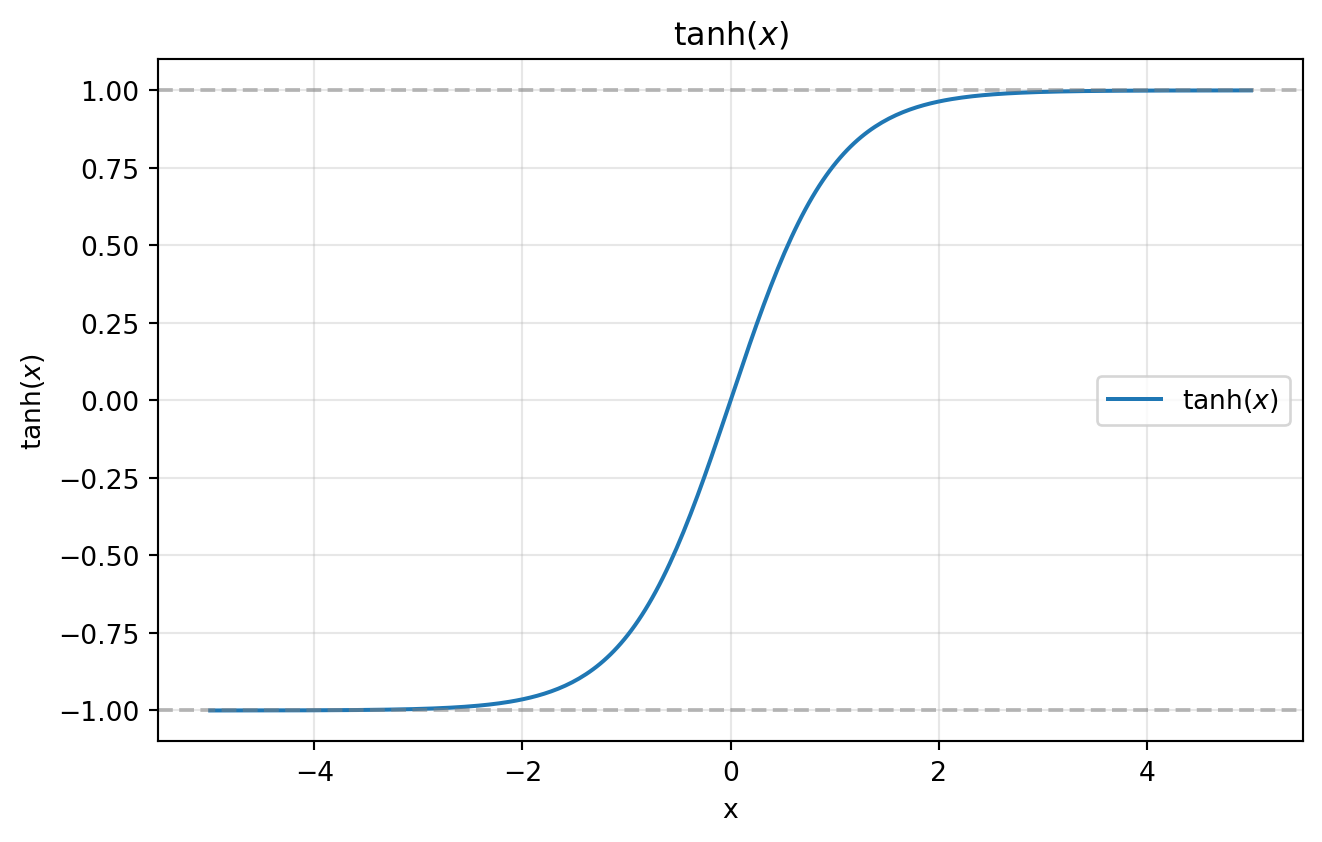
tanh関数のplot
import matplotlib.pyplot as plt
import numpy as np

x = np.linspace(-5, 5, 300)
y = np.tanh(x)

fig, ax = plt.subplots(figsize=(7, 4.5))
ax.plot(x, y, label=r"$\tanh(x)$")
ax.axhline(y=1, linestyle="--", color="gray", alpha=0.5)
ax.axhline(y=-1, linestyle="--", color="gray", alpha=0.5)
ax.set(xlabel="x", ylabel=r"$\tanh(x)$", title=r"$\tanh(x)$")
ax.legend()
ax.grid(True, alpha=0.3)
plt.tight_layout()
plt.show()定理 1 シグモイド関数との関係
シグモイド関数
$$ \sigma(a) = \frac{1}{1 + \exp(-a)} $$
について,
tanh (a) = 2σ(2a) − 1
定理 2 ロジスティクシグモイド関数とtanh線型結合関数の等価性
シグモイド基底関数による線形モデル
$$ y(\mathbf x, \mathbf w) = w_0 + \sum_{j=1}^{M} w_j \, \sigma\!\left(\frac{x - \mu_j}{s}\right) $$
と tanh 基底関数による線形モデル
$$ y(\mathbf x, \mathbf u) = u_0 + \sum_{j=1}^{M} u_j \, \tanh\!\left(\frac{x - \mu_j}{2s}\right) $$
は,以下のパラメータ変換により等価である:
$$ \begin{cases} u_0 = w_0 + \displaystyle\sum_{j=1}^{M} \frac{w_j}{2} \\[6pt] u_j = \dfrac{w_j}{2} \quad (j = 1, \dots, M) \end{cases} $$
例 2 数値的な検証
等価性の数値検証
import matplotlib.pyplot as plt
import numpy as np


def sigmoid(a):
    return 1 / (1 + np.exp(-a))


# --- パラメータ設定 ---
M = 4
rng = np.random.default_rng(42)
w = rng.standard_normal(M + 1)          # w_0, w_1, ..., w_M
mu = np.linspace(-3, 3, M)
s = 1.0

# --- パラメータ変換 ---
u_0 = w[0] + np.sum(w[1:]) / 2
u_rest = w[1:] / 2

# --- モデル評価 ---
x = np.linspace(-6, 6, 500)

y_sigmoid = w[0] + sum(
    w[j + 1] * sigmoid((x - mu[j]) / s) for j in range(M)
)
y_tanh = u_0 + sum(
    u_rest[j] * np.tanh((x - mu[j]) / (2 * s)) for j in range(M)
)

# --- プロット ---
fig, ax = plt.subplots(figsize=(7, 4.5))
ax.plot(x, y_sigmoid, label=r"sigmoid model $y(\mathbf{x}, \mathbf{w})$")
ax.plot(x, y_tanh, linestyle="--", label=r"tanh model $y(\mathbf{x}, \mathbf{u})$")
ax.set(xlabel="x", ylabel="y", title="sigmoid basis vs tanh basis")
ax.legend()
ax.grid(True, alpha=0.3)
plt.tight_layout()
plt.show()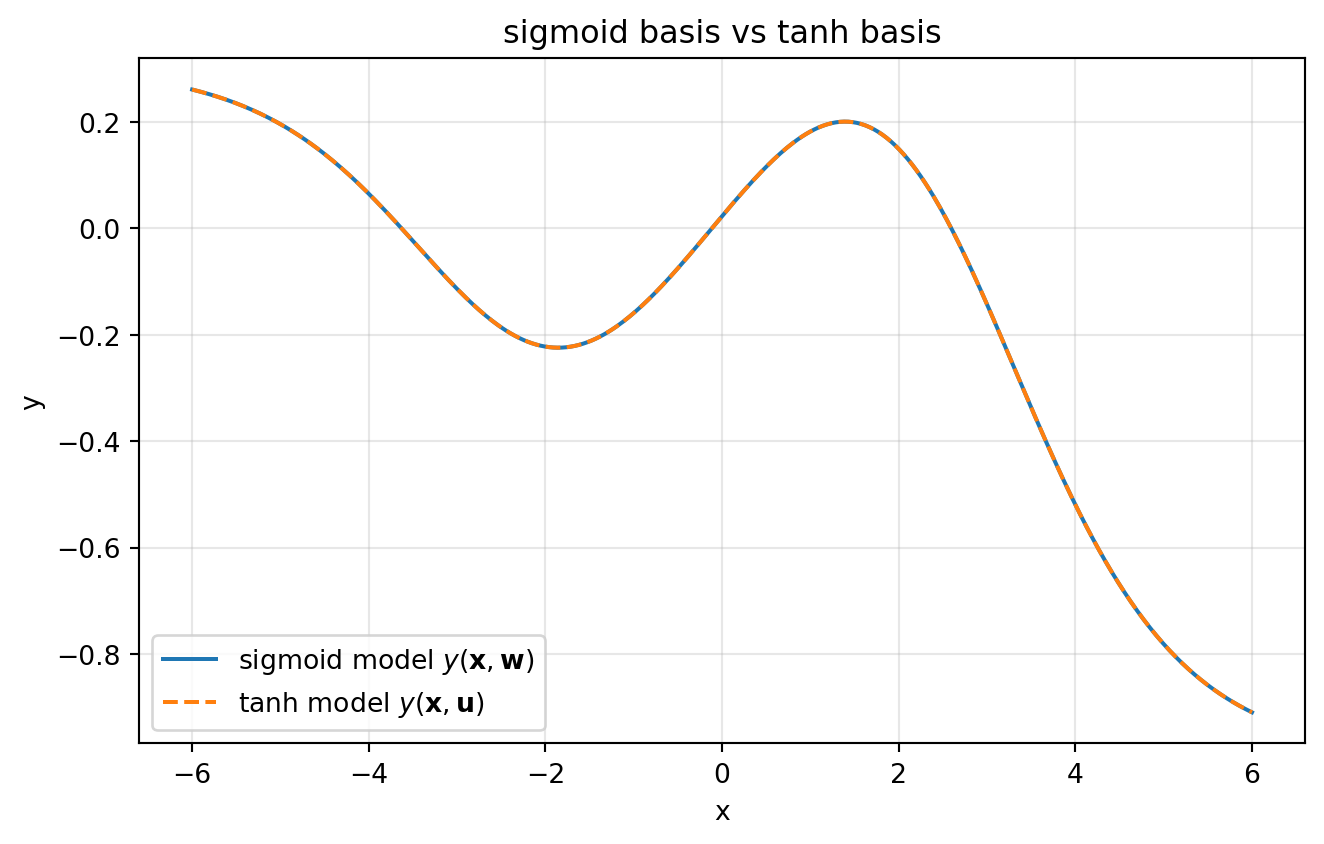
パラメータ変換後の2つのモデルが完全に一致することが確認できた.
ノート
- 数学的には等価であっても,浮動小数点演算では σ(a) → 1(または 0)と tanh (a) → ±1 に到達する速さが異なる
- tanh は引数が σ の半分のスケール(a/2 vs a)で評価されるため,同じ入力 a に対して飽和が遅く,勾配情報がより長く保たれる